
A mini-stroke happens when blood flow to part of the brain is briefly interrupted. The medical name is a transient ischemic attack, or TIA. Symptoms usually clear on their own within hours, which is exactly why they are easy to shrug off.
They are worth paying attention to, though. A mini-stroke is a sign that something in your circulation needs a closer look, and it normally gives you time to act on it. A mini-stroke and a stroke look the same when they start, and only an evaluation can tell them apart. Do not drive yourself to the hospital. You should call 911 for any sudden stroke-like symptoms, even if they stop completely.
That emergency visit answers can help determine whether a stroke is happening at that moment, but it does not answer what caused the episode, or what to change so it does not happen again. Those answers come afterward, from a neurologist. That follow-up is the part the neurology team at Atlanta Neuroscience Institute handles. We go through what happened, explain your results in plain language, and build a prevention plan with you.
TIA & Stroke: What You Need To Know
| Symptoms | Sudden weakness/numbness, speech difficulty, vision changes, balance problems, and other stroke symptoms |
| Can symptoms go away? | Yes. Symptoms may improve or disappear, but that does not mean it is safe to wait. |
| What should you do? | Call 911 immediately, even if symptoms resolve |
| How are they distinguished? | Medical evaluation and brain imaging help determine whether a TIA or stroke occurred |
What Is a Mini-Stroke (TIA)?
In a TIA (also referred to as a mini-stroke), a narrowed artery or a small clot briefly cuts off blood flow to part of the brain. The blockage clears on its own, usually before it does lasting damage. That is the difference between a mini-stroke and a stroke, where the damage becomes permanent.
The symptoms are the same in both, which is why they are treated the same in the moment.
- Weakness or numbness in the face, arm, or leg, usually on one side
- Trouble speaking, finding words, or following what someone is saying
- Blurred vision or loss of vision usually in only one eye
- Dizziness, loss of balance, or trouble walking steadily
- Sudden confusion or trouble concentrating
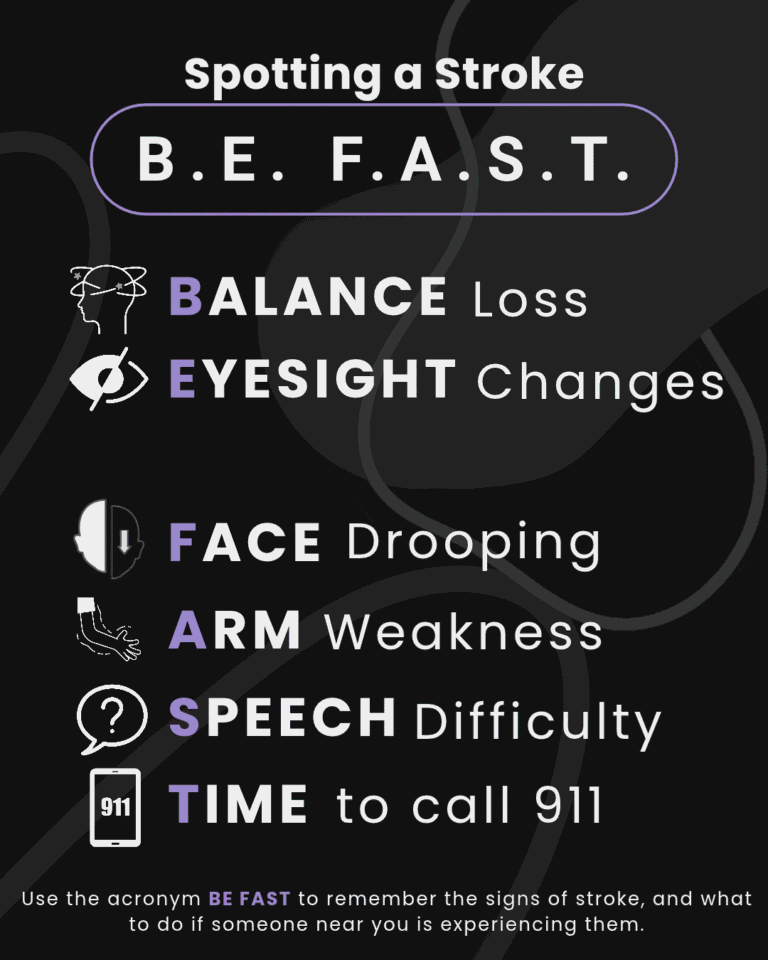
Emergency teams use the word BE FAST to make the most common signs easier to remember: Balance, Eye Sight, Face drooping, Arm weakness, Speech difficulty, Time to call 911.
Why a Mini-Stroke (TIA) Is Worth Taking Seriously
A TIA (also referred to as a mini-stroke) is often the first clear sign that something is affecting blood flow to the brain. The usual causes are narrowed arteries, an irregular heart rhythm such as atrial fibrillation, a clotting disorder, or blood pressure that has been high for a long time. None of those tend to announce themselves on their own.
A 2025 JAMA meta-analysis of people who had a TIA (mini-stroke) or minor stroke found the risk of a later stroke was about 5.9% within one year, 12.8% within five years, and 19.8% within ten years.
Those numbers are a reason to get checked, but not a reason to panic. Research published in Continuum found that up to 80% of strokes that follow a TIA (mini-stroke) can be prevented once the cause is found and treated.
Finding that cause is the whole purpose of the follow-up visit.
What Happens at Your Neurology Visit
Most of the visit is conversation rather than testing. The usual order looks like this.
- Talking through what happened. Your neurologist goes through the timeline with you, and with anyone who saw the episode, along with your health history and the medications you take.
- A neurological exam. A hands-on check of reflexes, balance, vision, coordination, and nerve function. Nothing about it is invasive.
- Imaging, if you need it. An MRI or CT of the brain, and often imaging of the blood vessels in your neck to see how well blood is moving.
- Heart and blood tests. Your neurologist may recommend heart rhythm monitoring, such as an EKG or Holter monitor, and order blood work to check cholesterol, blood sugar, and clotting
Not everyone needs every test. Your neurologist will tell you why each one is on the list before you have it.
What Treatment Usually Involves
Once the cause is clear, treatment is mostly about keeping blood moving and keeping a clot from forming again. Depending on what the evaluation turns up, a plan may include:
- Medication for blood pressure, cholesterol, or clot prevention
- Treatment for a specific condition found along the way, such as atrial fibrillation
- Changes to daily habits, including diet, exercise, and sleep
How often you come back in is worth asking about directly. Your doctor can set a follow-up schedule that fits your situation, and that schedule usually changes as things settle.
Frequently Asked Questions About Mini-Strokes (TIA’s)
What should I bring to my neurology follow-up?
Bring your hospital or emergency room discharge summary, copies or discs of any imaging, a current medication list, and a short written timeline of what happened. If someone saw the episode, bring them along. They often remember details you do not.
Can something else cause symptoms that feel like a mini-stroke (TIA)?
Yes. Migraine with aura, seizures, inner-ear problems, and a sudden drop in blood sugar can all cause temporary symptoms that look similar. That overlap is the main reason an evaluation matters, since symptoms alone are not reliable enough to go on.
Can an MRI confirm a mini-stroke (TIA) happened?
Not on its own. An MRI shows whether there is lasting damage and rules out other causes, but because a TIA is temporary by definition, a normal scan is common and expected. Your neurologist reads the scan alongside your history rather than in isolation.
Should family members take notes during an episode?
Yes, and the single most useful detail is the time symptoms started. Note what changed and how long it lasted. Emergency doctors and neurologists both work backward from that timeline.
How soon should I follow up after a mini-stroke (TIA)?
Ask your doctor, since the right timing depends on what the emergency evaluation found and what still needs checking. If you have been discharged without a follow-up already scheduled, call and get one on the calendar rather than waiting to be contacted.
Next Steps
A TIA (also referred to as a mini-stroke) is a warning you can act on, and most of what happens next is decided in the weeks afterward rather than during the episode itself.
If you or someone in your family needs follow-up after a mini-stroke in Atlanta, Atlanta Neuroscience Institute can help. Request an appointment or call 404-351-0205.