
How New Neurological Treatments Become Available to Patients
When a new treatment for Alzheimer’s disease, Parkinson’s disease, Multiple Sclerosis, epilepsy, or another neurological condition makes headlines, many people wonder: How did we get here?
The answer is that new treatments do not appear overnight. Every medication, therapy, and medical breakthrough available today began as an idea that underwent years of scientific research, testing, and evaluation before reaching patients.
Understanding this process can help patients appreciate the important role research plays in advancing neurological care and improving lives.
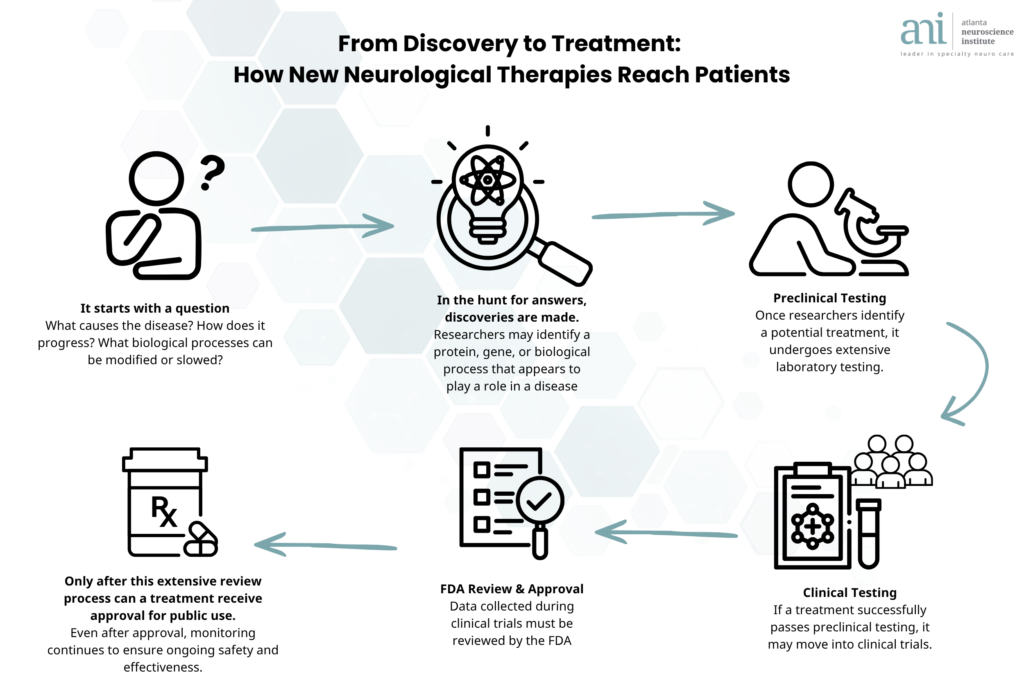
It Starts with Scientific Discovery
Every new treatment begins with a question.
Researchers may identify a protein, gene, or biological process that appears to play a role in a disease. For example, scientists studying Alzheimer’s disease may investigate how certain proteins contribute to memory loss, while researchers studying Parkinson’s disease may focus on the loss of dopamine-producing cells in the brain.
These discoveries help researchers identify potential targets for future treatments.
At this stage, scientists are asking:
- What causes the disease?
- How does it progress?
- What biological processes can be modified or slowed?
Finding answers to these questions lays the foundation for future therapies.
Laboratory Testing Comes Next
Once researchers identify a potential treatment, it undergoes extensive laboratory testing.
Scientists evaluate whether the treatment affects the intended target and whether it appears safe. Many potential therapies never move beyond this phase because they fail to demonstrate effectiveness or raise safety concerns.
Researchers also study how a treatment behaves in the body, including how it is absorbed, processed, and eliminated.
This stage helps determine whether a treatment has enough promise to justify further investigation.
Clinical Trials Bring Research to Patients
If a treatment successfully passes preclinical testing, it may move into clinical trials.
Clinical trials are carefully designed research studies involving human participants. These studies help researchers understand whether a treatment is safe, effective, and appropriate for widespread use.
Clinical trials typically occur in several phases:
Phase 1: Safety
Researchers evaluate the treatment’s safety profile and determine appropriate dosing.
Phase 2: Effectiveness
Researchers study whether the treatment works for patients with the condition being investigated while continuing to monitor safety.
Phase 3: Large-Scale Evaluation
The treatment is studied in a much larger group of participants to confirm effectiveness, compare outcomes, and identify less common side effects.
Throughout every phase, patient safety remains the top priority.
FDA Review and Approval
Before a treatment can become widely available, the data collected during clinical trials must be reviewed by the FDA.
The FDA evaluates:
- Safety data
- Clinical trial results
- Manufacturing standards
- Potential risks and benefits
Only after this extensive review process can a treatment receive approval for public use.
Even after approval, monitoring continues to ensure ongoing safety and effectiveness.

Why Does Research Take So Long?
Patients and families often wonder why new treatments can take years to become available.
The answer is simple: safety matters.
Researchers must carefully evaluate potential therapies before recommending them to the public. While this process requires significant time and resources, it helps ensure that treatments are both safe and effective.
Many neurological conditions are complex, and researchers are continually working to better understand these diseases and develop new approaches to treatment.
The Important Role Patients Play
Medical breakthroughs would not be possible without patients who choose to participate in research.
Clinical trial participants help researchers answer critical questions about safety, effectiveness, and long-term outcomes. Their involvement contributes to medical knowledge that could benefit future generations of patients.
In many cases, participation may also provide access to promising therapies that are not yet widely available.
Advancing Neurological Care Through Research
Research remains one of the most important drivers of progress in neurology. Today’s treatments exist because patients, physicians, and researchers worked together to advance scientific understanding and explore new possibilities.
At Atlanta Neuroscience Institute, our research team helps connect eligible patients with clinical research opportunities that may contribute to the future of neurological care. Through ongoing research efforts, we remain committed to advancing knowledge, improving treatments, and helping shape the next generation of neurological care.
Every breakthrough starts somewhere. Through research, discovery becomes possibility, and possibility becomes hope for patients and families facing neurological disease.
Written by Josh Mann |
Medically Reviewed by Joash Lazarus, MD, Board Certified Neurologist at Atlanta Neuroscience Institute
Reviewed on June 4, 2026